For business clients only. By opening Stripe Checkout, you confirm that you are acting for a business or professional organization.

Execution terrain

Execution breaks before performance does.

These cases show where ownership, control, process and decision logic failed, and what was changed before more tools or activity were added.

For whom
CFOs, CPOs and transformation leads who own P2P / S2P execution.
When
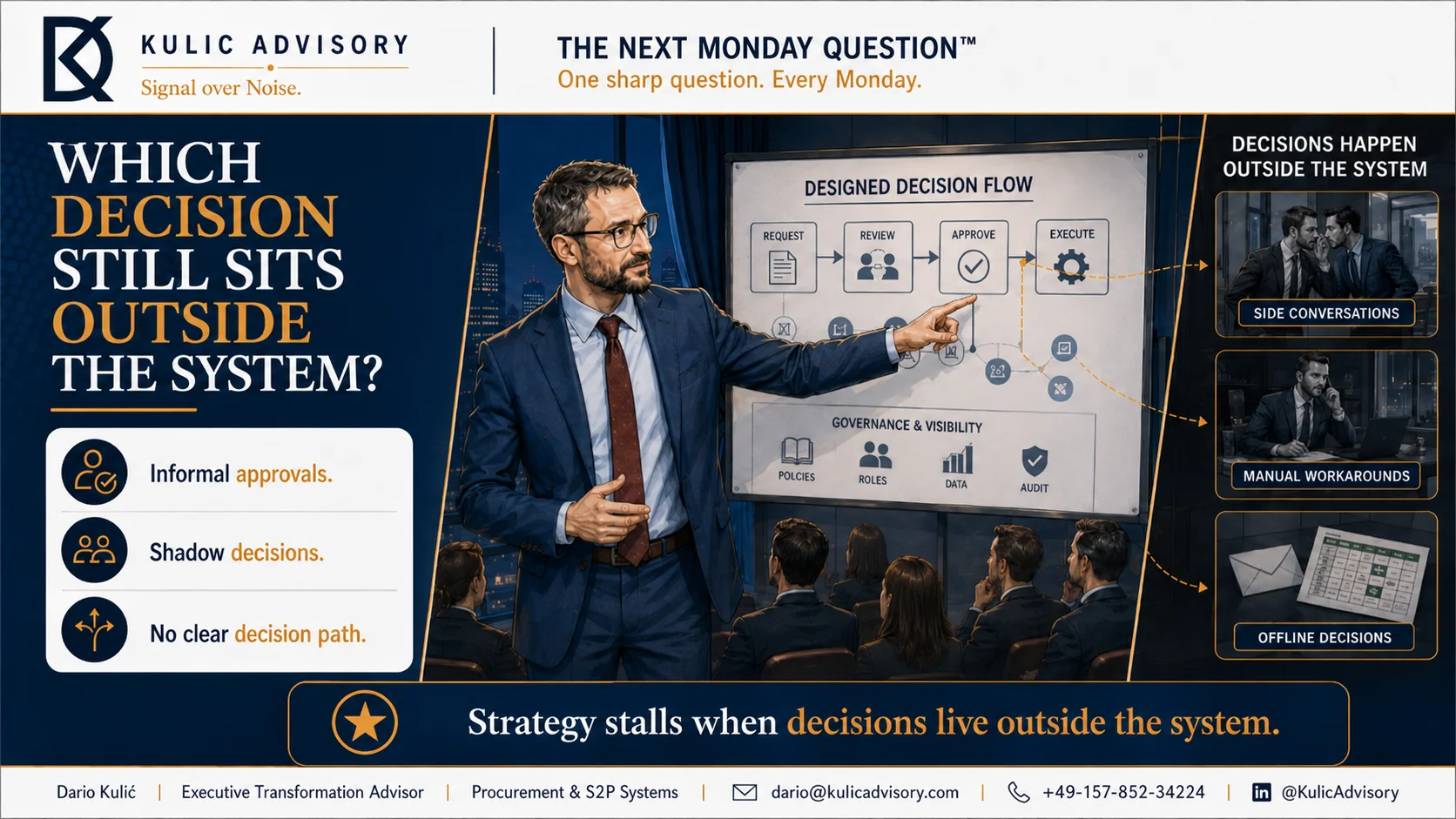
Activity is visible, but ownership, control and decision paths are not - and more tooling is on the table.
Output
One flagship case and four bounded cases: named break, governed move, evidence with class, status and boundary.

FLAGSHIP CASE · P2P EXECUTION ARCHITECTURE

AICTIONBOT™

AI is the layer. Governed execution is the system.

Flagship case

AICTIONBOT™ is not a chatbot and not a loose automation claim. It is a governed P2P execution architecture used to make the real work visible: what can move automatically, what must remain controlled, where human judgment is required, and who owns every exception.

Situation
Recurring approvals, invoice exceptions, supplier updates and missing decisions were distributed across fragmented tools and manual handoffs. Teams spent time chasing work that had no single accountable execution path.
Break
The workload was visible, but the execution system was not. Exception ownership, control thresholds, escalation rules, data responsibility and value logic were not explicit enough to support safe automation.
Move
KULIC translated workload and process friction into a governed automation business case connecting the real P2P flow with ownership logic, control points, prioritized use cases, value logic and a phased Discover-Design-Pilot-Scale route.
Outcome
Internal business-case logic identified approximately 4M in modeled value potential. A supporting workload analysis identified more than 24 annual manual-equivalent years for possible removal.
Evidence class
Primary: Class C - modeled value potential. Supporting: Class D - effort / workload signal.
Validation status
Internal anonymized business-case logic is documented. The result is not externally audited.
Boundary
Modeled potential is not realized savings. The workload signal is not a cash outcome. Assumptions, period, sensitivity, implementation cost, technology stack and effort-to-cash conversion are not public. Currency is omitted until the original source model confirms whether the 4M figure is EUR or USD.
Next move
Start with one recurring P2P exception. Confirm owner, rule, control, data and escalation path before funding a broader automation rollout.
Diagnose the P2P break

Four supporting cases

The cases that complete the pattern.

Each case uses the same evidence fields: situation, break, move, outcome, evidence class, validation status, boundary and next move.

Case 01 · Class B

P2P Organizational Restructuring

Situation
A P2P organization showed structural friction across roles, responsibilities and execution ownership. Cost pressure was visible, but the opportunity was not limited to negotiation.
Break
Fragmented ownership, unclear role boundaries and duplicated effort were creating hidden structural cost. Activity was visible; accountability was not.
Move
Simplify the operating model, clarify roles, redesign ownership and align governance around the actual P2P execution flow.
Outcome
More than USD 1M in cost reduction was reported through P2P organizational restructuring.
Evidence class
Class B - Implemented outcome.
Validation status
Existing anonymized implemented-outcome statement; not externally audited.
Boundary
Baseline, period, source system and internal validating role are not public. This is not a benchmark or guarantee.
Next move
Map the cost-to-serve and ownership model before setting another generic cost target.
Open case
Case 02 · Class B

Shared Service Renegotiation

Situation
A shared-service setup required stronger commercial discipline around scope, expectations, accountability and governance.
Break
Value leakage came from ambiguous scope, fragmented accountability and reactive cost discussions, not only from price.
Move
Clarify scope, strengthen accountability, reframe commercial expectations and install a more governable service model.
Outcome
More than USD 1M in cost reduction was reported through shared-service negotiation.
Evidence class
Class B - Implemented outcome.
Validation status
Existing anonymized implemented-outcome statement; not externally audited.
Boundary
Baseline, period, contract scope and internal validating role are not public. This is not an outsourcing benchmark.
Next move
Make included scope, excluded scope, owner and service measure explicit before reopening the rate card.
Open case
Case 03 · Class B

S/4HANA Outline Agreement Control

Situation
An S/4HANA procurement environment required stronger control through better use of Outline Agreements and system-enabled procurement structures.
Break
The technology existed, but governed usage did not. System capability was not translating automatically into procurement control.
Move
Strengthen agreement usage, system-enabled structures and governed execution logic in S/4HANA.
Outcome
Approximately USD 450K in cost avoidance was reported through Outline Agreements.
Evidence class
Class B - Implemented outcome.
Validation status
Existing anonymized implemented-outcome statement; not externally audited.
Boundary
Period, calculation method, source system and internal validating role are not public. Cost avoidance is not cash savings.
Next move
Trace one purchasing flow from agreement availability to actual user behavior and leakage.
Open case
Case 04 · Class D

S2P Taxonomy & Ownership Rollout

Situation
A multi-entity S2P environment showed uneven adoption, regional workarounds and unclear escalation across procurement, finance and operations.
Break
The organization lacked a shared process taxonomy, explicit ownership map and common decision path. Rollout activity was running ahead of the operating model.
Move
Build and validate an L4 process taxonomy, RASCI/ownership logic, handoff map, governance rhythm and a phased 12-month harmonization and rollout route.
Outcome
The public working sample shows a standardized taxonomy route, clearer handoffs and ownership, governance checkpoints and an SLA-linked operating-model path. No financial or adoption result is publicly validated.
Evidence class
Class D - Method / control evidence.
Validation status
An anonymized working sample and roadmap are public; quantitative outcome validation is not public.
Boundary
This proves method depth and implementation logic, not a financial result or universal rollout benchmark.
Next move
Start with one disputed cross-functional flow and freeze taxonomy, ownership and escalation before scaling the rollout.
Open method

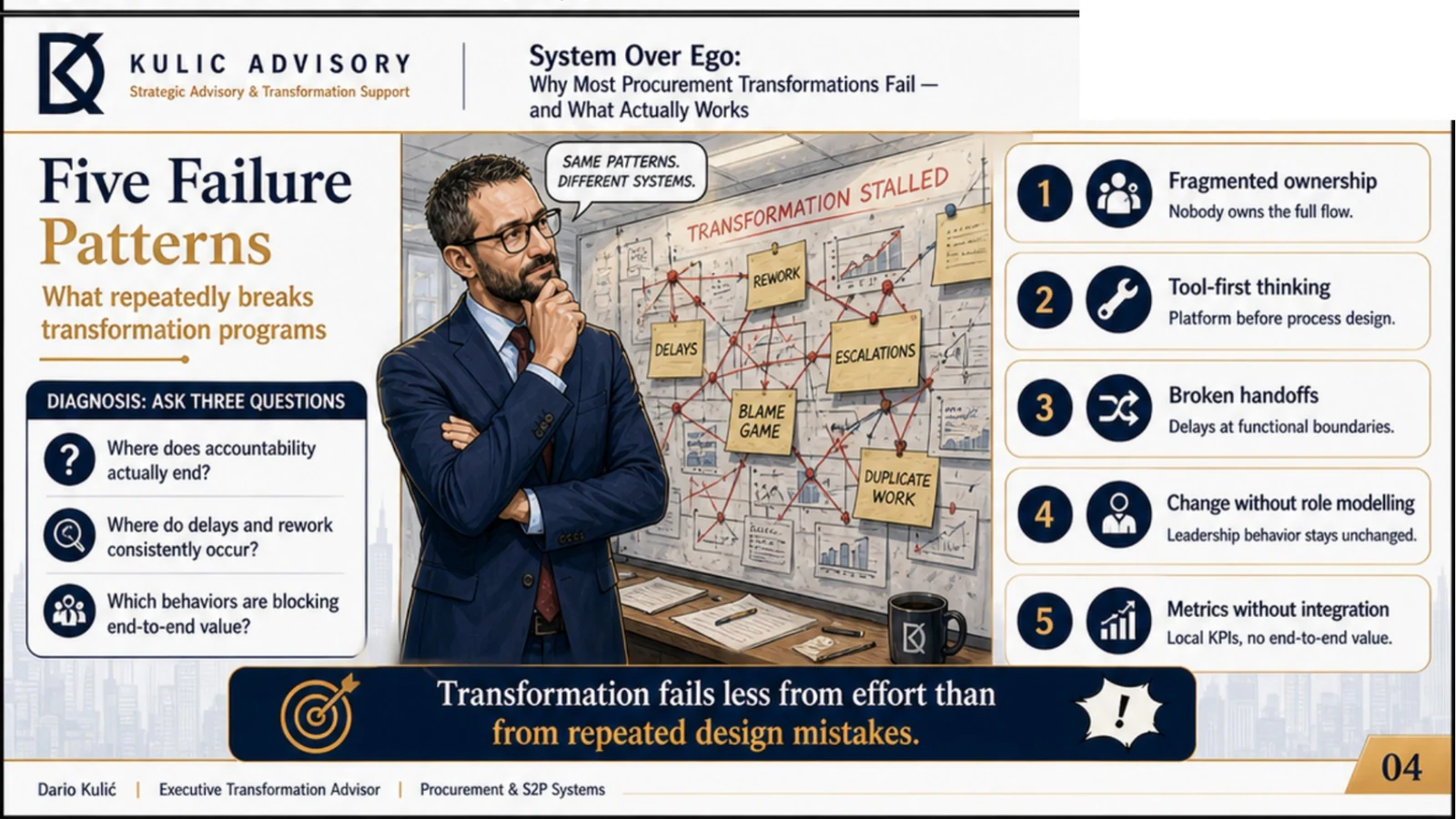
Recurring patterns

Three breaks show up again and again.

01

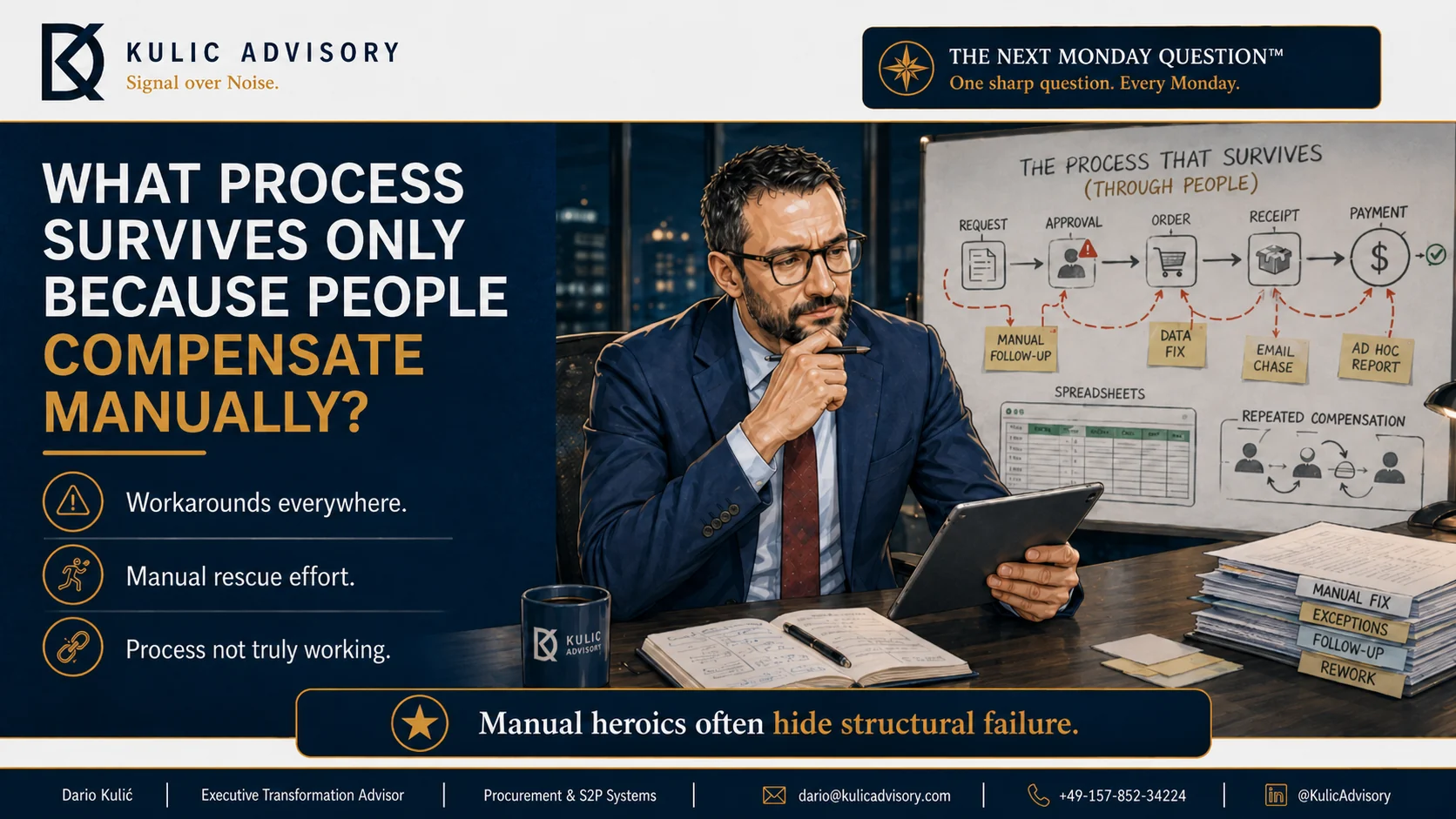
Ownership is fragmented.

Work crosses functions, but accountability stays local, unclear or duplicated.

02

Tools automate undefined work.

Automation scales confusion when owner, rule, control, data and exception logic are not explicit.

03

Governance measures activity instead of movement.

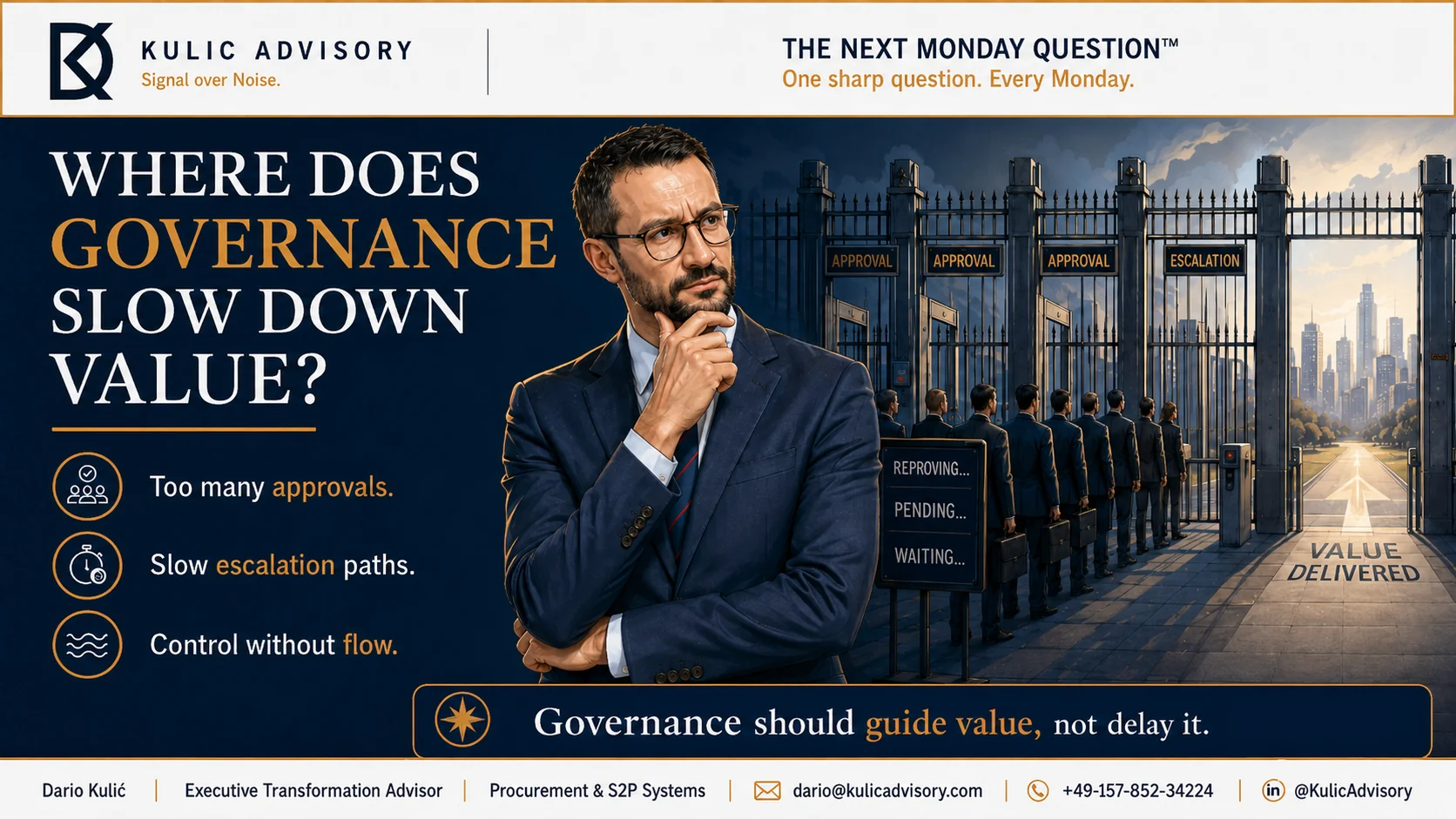
Meetings, dashboards and status rituals only matter when they create a governed next move.

Decision Signal Lab

Run one real execution break through the system.

Choose the break, compose the four conditions and lock the fingerprint. The exact combination changes the diagnosis, risk, next move, route and downloadable PDF brief.

Input
One live break
Output
PDF decision brief
Data
Stays in this browser
Run the filter
DECISION SIGNAL LAB / LIVE1 scenario · 16 possible fingerprints
01 · Execution-break scenario

Choose the visible break. The four conditions determine the diagnosis.

Processed locally. Nothing is submitted or stored.
02 · Decision fingerprint composer

Select a scenario, then set the four conditions.

Binary signature----

Each condition changes one bit and selects a different fingerprint.

NOT ANALYZEDChoose a scenario to load its control conditions.
03 · Four diagnostic conditions

Set each condition to open or explicit. These inputs control the composer.

04 · 16 possible fingerprints

Choose a pattern directly or compose it above. Every combination produces a different read.

05 · FINGERPRINT RESULTWAITING

Choose one break to start.

The composer will not issue a diagnosis until you analyze a specific combination.

Primary risk
Not assessed.
Next accountable move
Choose the break that is consuming executive attention.
Recommended route
Appears after analysis.
Stage
Signal strength0%
Open recommended route

0/4 conditions explicit

Signature presentation · System over Ego

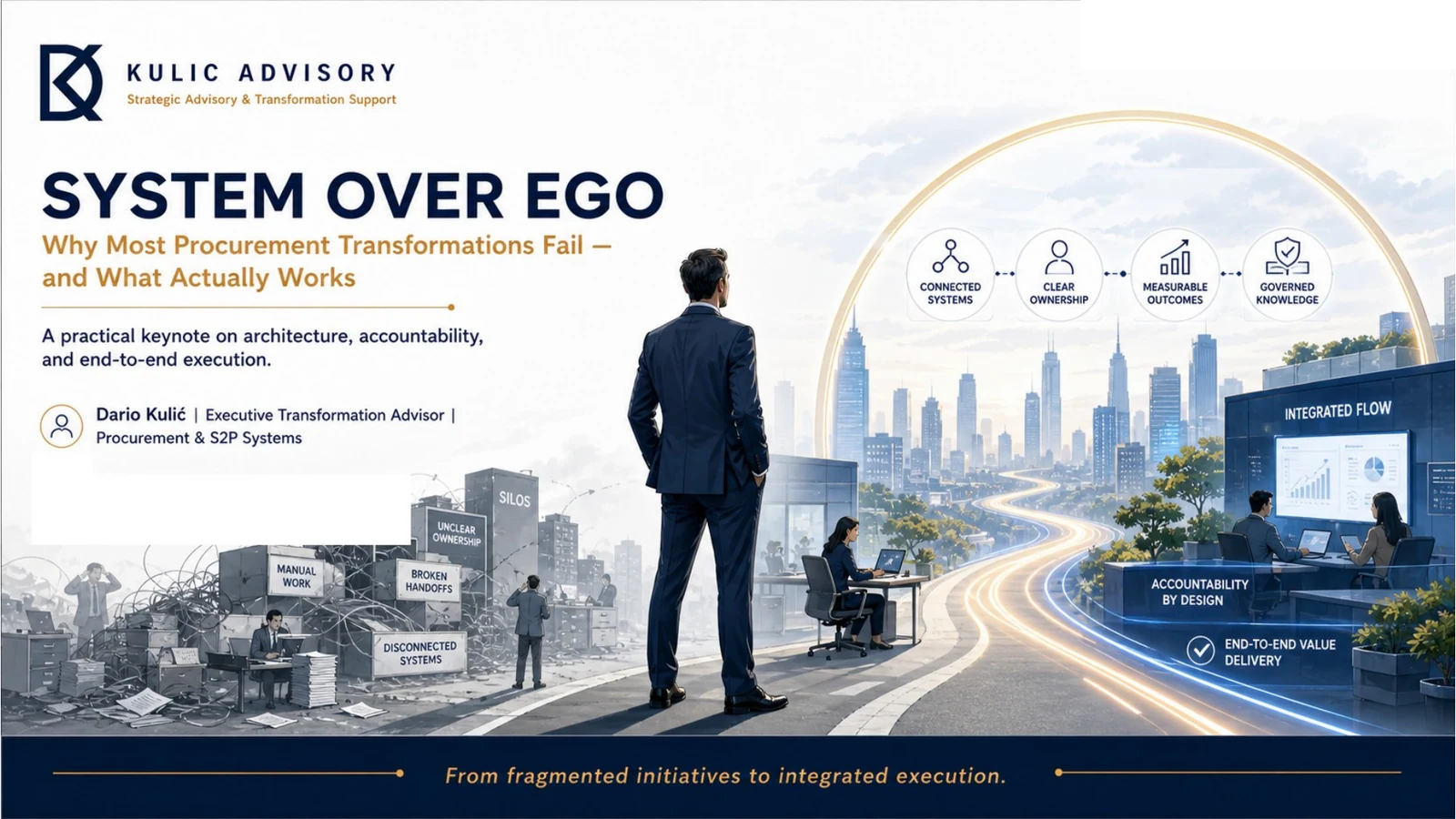
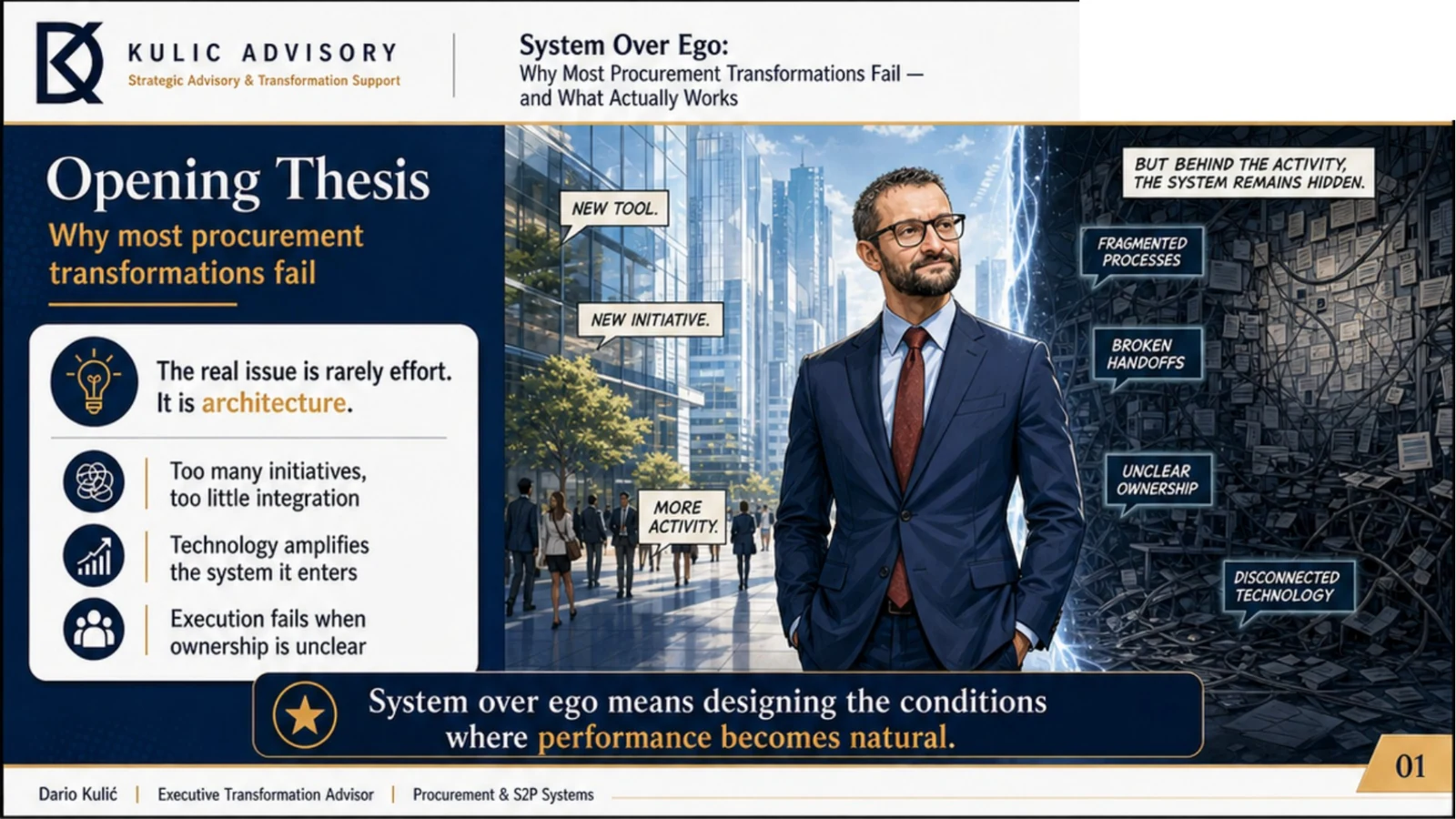
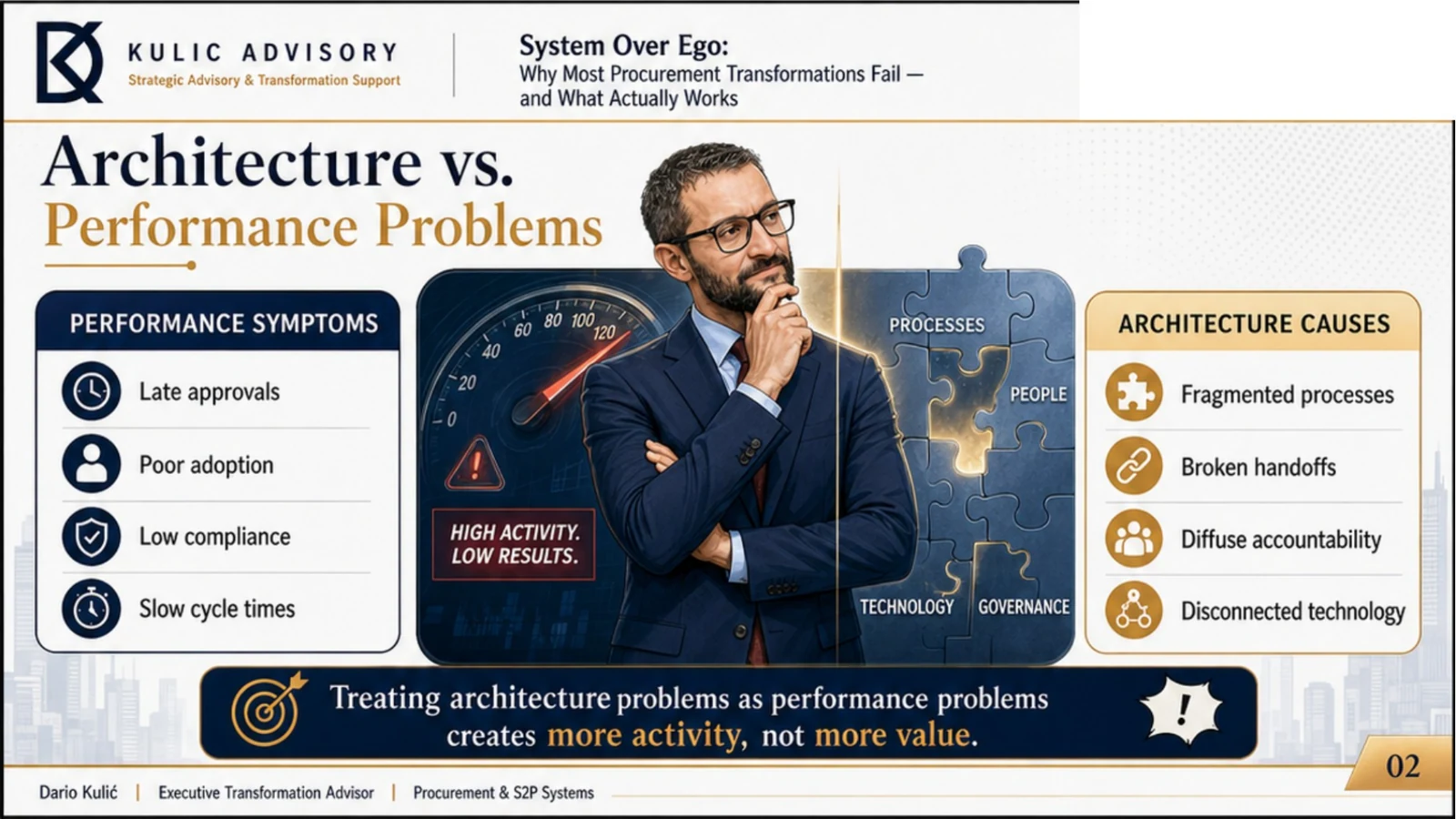
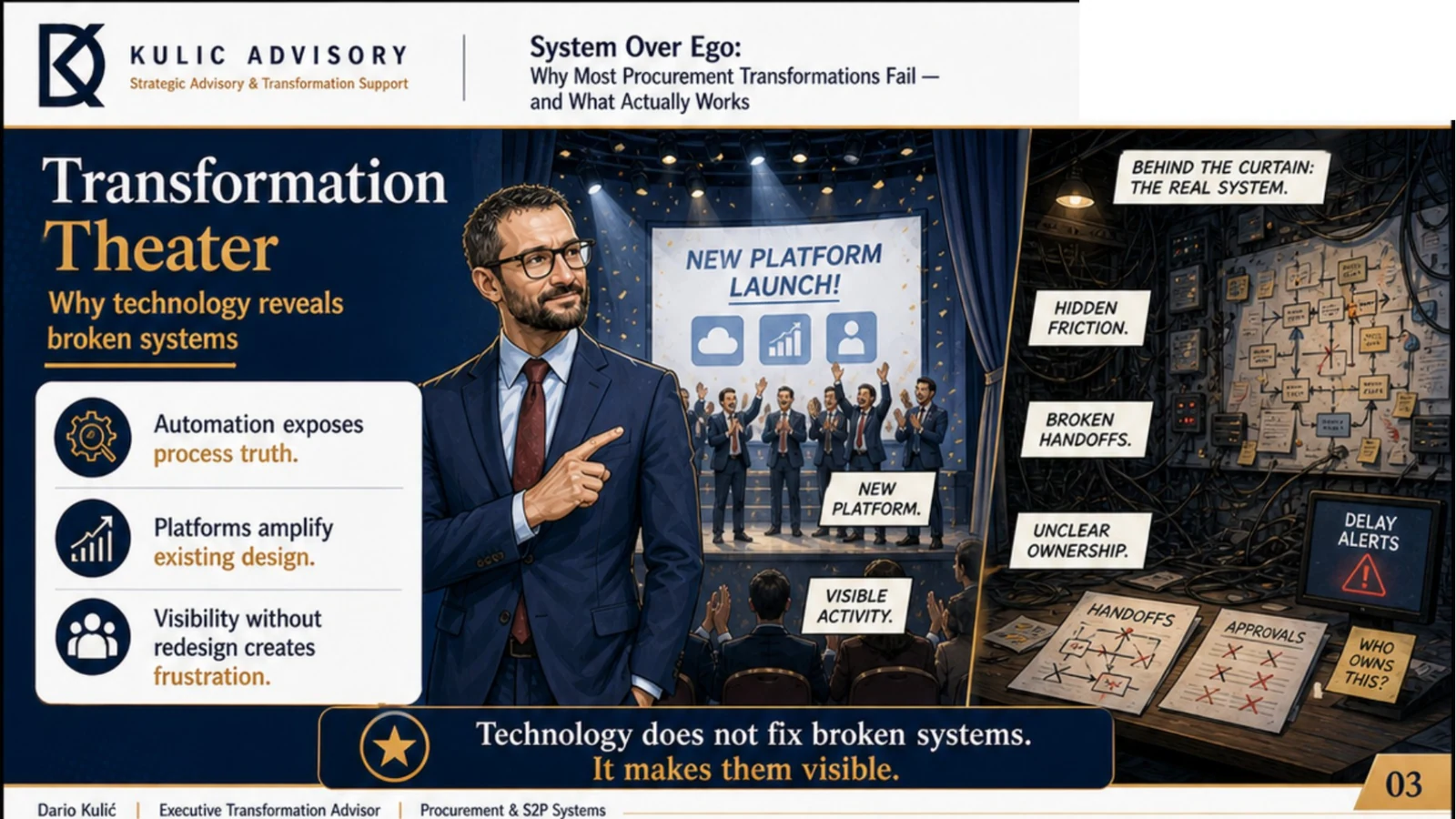
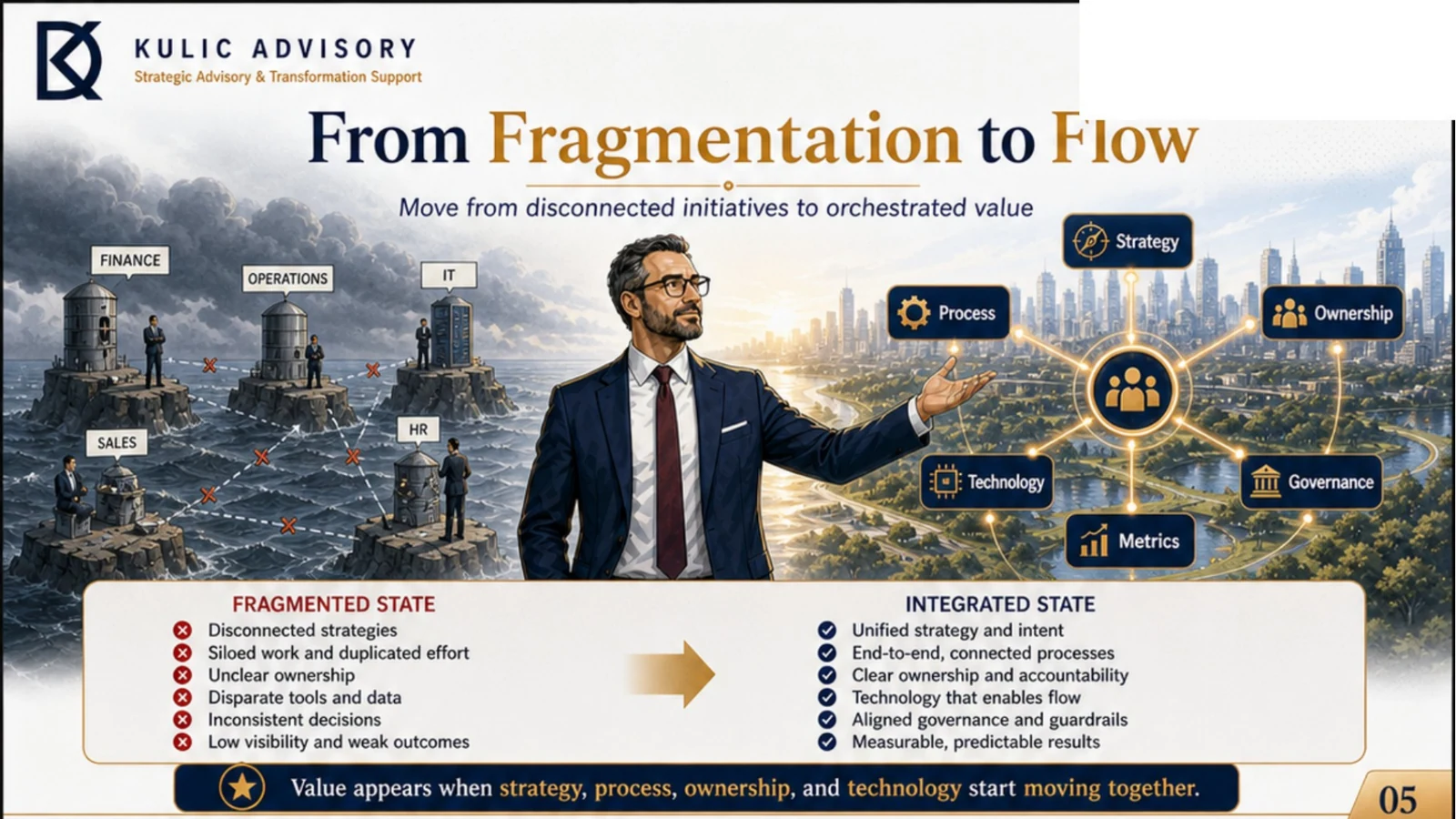
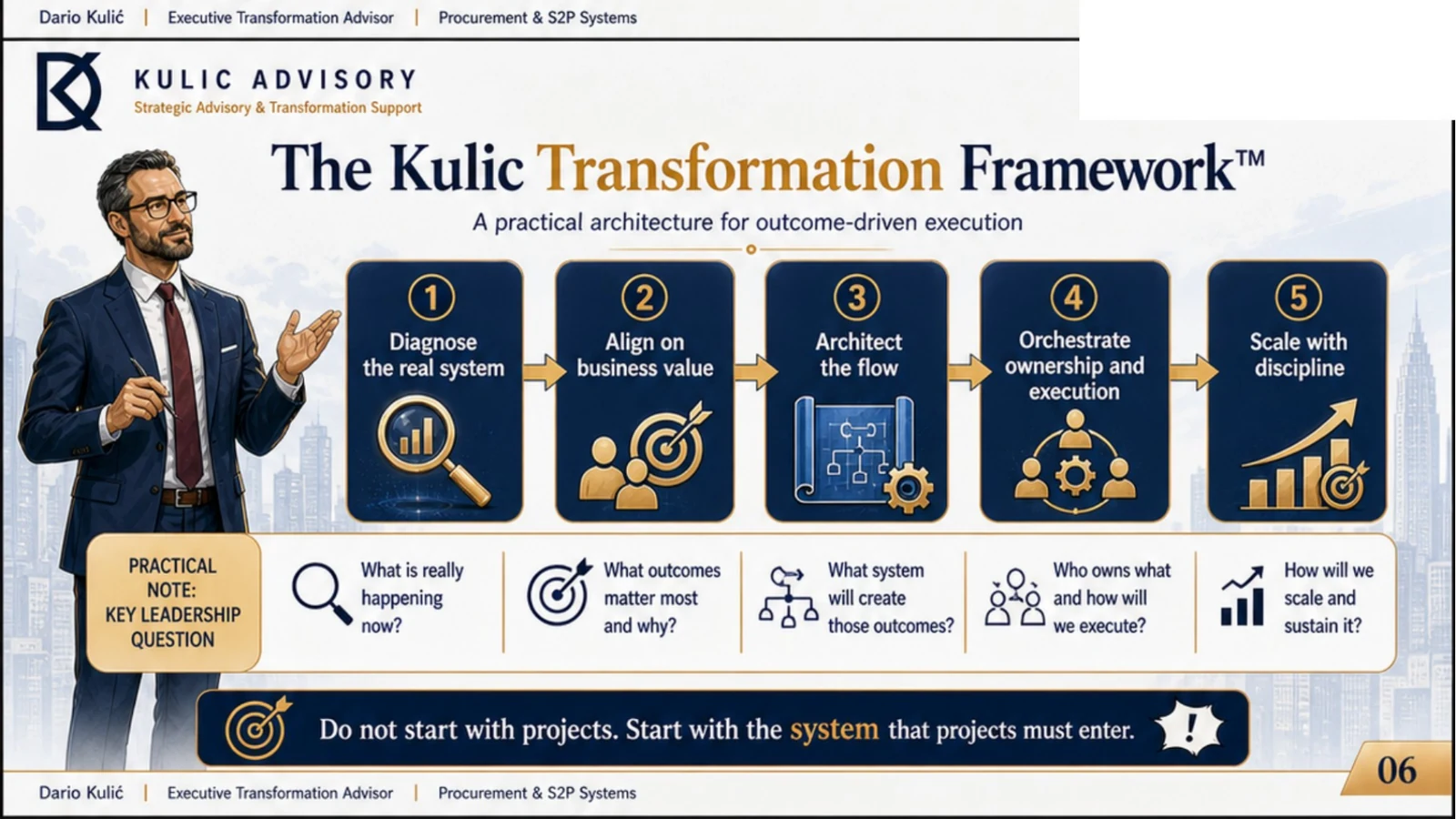
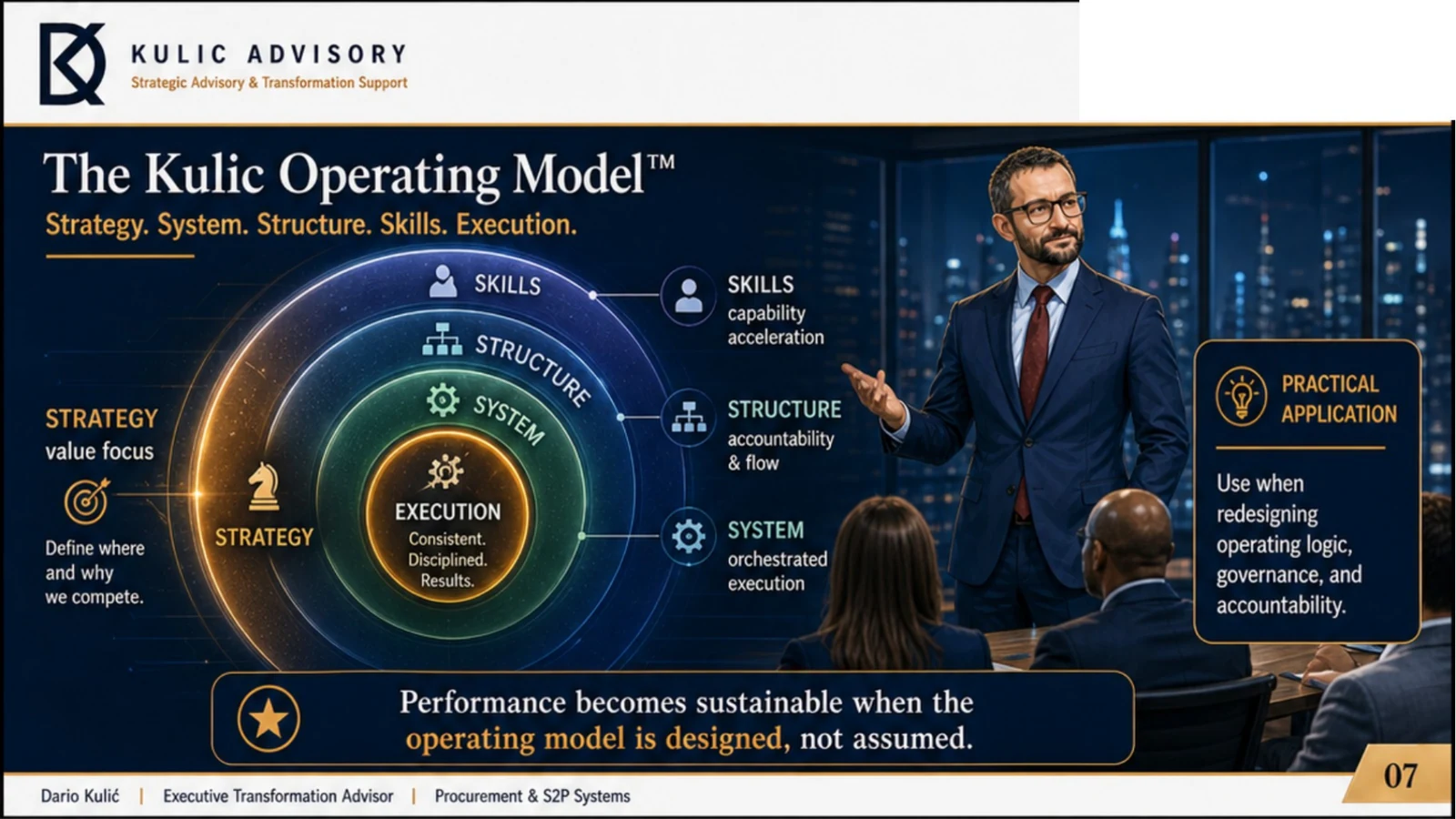
Eight slides you can inspect before you decide.

The opening sequence makes the argument visible: performance problems are often architecture problems. Review eight selected slides here. The complete 20-slide presentation is released after a short business-contact handover.

Full presentation · 20 slides

Continue the argument beyond the preview.

Leave your business contact details to receive the full PDF immediately. No phone number is requested.

  • 20-slide signature presentation
  • System, governance and execution logic
  • Download released directly after valid submission

Proof + next step

Evidence stays bounded. The next move stays practical.

No individual case repeats the aggregate proof signal. The page uses evidence class, validation status and boundary to keep the claim clean.

Evidence legend

Class B: implemented outcome. Class C: modeled value potential. Class D: method, control or workload signal.

Case boundary

Public proof is anonymized, not externally audited unless stated, and not a benchmark or guarantee.

Measured, not claimed

The same discipline applies to this site itself. Documented field sample from real visits (Cloudflare Web Analytics RUM, 24-hour window, recorded 18-19 July 2026): LCP P75 601 ms, CLS 100% good, INP 89% good. Field values vary over time; this is a dated, measured sample - not a live feed and not a guarantee.